Artificial Intelligence as a tool – Professional Judgement is required
AI Is a Powerful Tool — But Not a Substitute for Professional Judgement
Artificial intelligence is changing the way information is researched, texts are prepared, contracts are analyzed and documents are structured. AI can also provide valuable support in Contract & Claim Management: in the initial review of documents, in drafting texts, in structuring arguments or in summarizing complex facts.
But this is precisely where the limitation lies: AI can support the process, but it does not replace the professional understanding required to correctly assess contract mechanisms, claim situations, risks, deadlines, evidence and negotiation strategies.
Anyone who wants to use AI effectively in Contract & Claim Management must know which questions to ask, which results need to be critically reviewed and where commercial, legal or project-related risks may arise. This is exactly the understanding provided by the training programs of the Contract Academy.

Contract & Claim Management Requires More Than Text Processing
At first glance, AI appears capable of performing many tasks: it can summarize contract clauses, draft correspondence, organize arguments or create checklists. In day-to-day project work, however, the objective is not merely to produce texts.
What matters is professional assessment:
- Which deviation is actually relevant for a claim?
- Which contractual obligation has been breached?
- Which deadline must be observed?
- What evidence is required?
- Which costs or schedule consequences can be causally attributed?
- Which position is negotiable — and which is not?
- Which statement could later be used against your own company?
These questions cannot be answered by AI alone. They require an understanding of the mechanisms of Contract & Claim Management, project logic, contract structure and the commercial interests of the parties involved.

Without Professional Expertise, AI Can Even Increase Risks
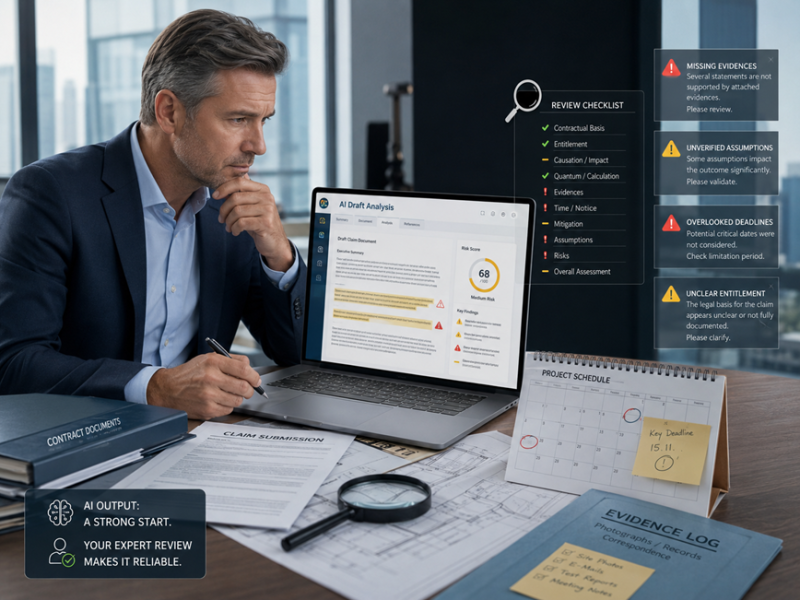
AI generates results based on probabilities, patterns and available information. It can formulate convincing texts even when the professional basis is incomplete, incorrect or strategically unsuitable.
This can be particularly dangerous in Contract & Claim Management. A professionally worded letter is not automatically a good letter. A well-formulated argument is not automatically enforceable. A summary of a claim does not replace the examination of the legal or contractual basis, causation, evaluation and evidence.
Those who do not master the fundamentals risk:
- setting the wrong priorities,
- overlooking contractual deadlines,
- adopting unproven assertions,
- presenting claim positions in a strategically unfavorable way,
- creating risks through communication,
- considering AI results to be reliable without proper review.
AI can accelerate work. But it cannot decide whether a claim is actually robust.
Training Creates the Foundation for the Effective Use of AI
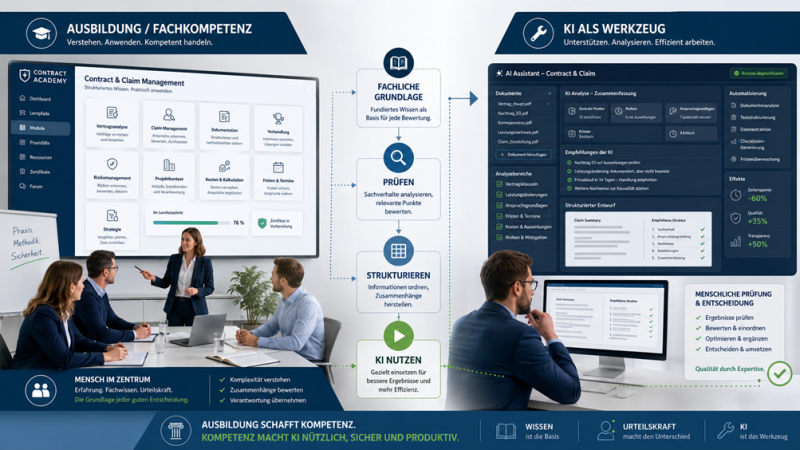
The programs of the Contract Academy provide the professional foundations required to use AI competently in Contract & Claim Management. Participants learn to understand contract mechanisms, correctly assess changes and disruptions, examine the basis for claims and structure claim situations systematically.
Only with this knowledge can AI be used effectively: not as a substitute for professional competence, but as a tool to increase efficiency.
Those who understand the system can use AI in a targeted way to prepare drafts, structure arguments, analyze documents or develop communication options. At the same time, people remain able to professionally review, correct and strategically assess the results.
Good Prompts are based on competency
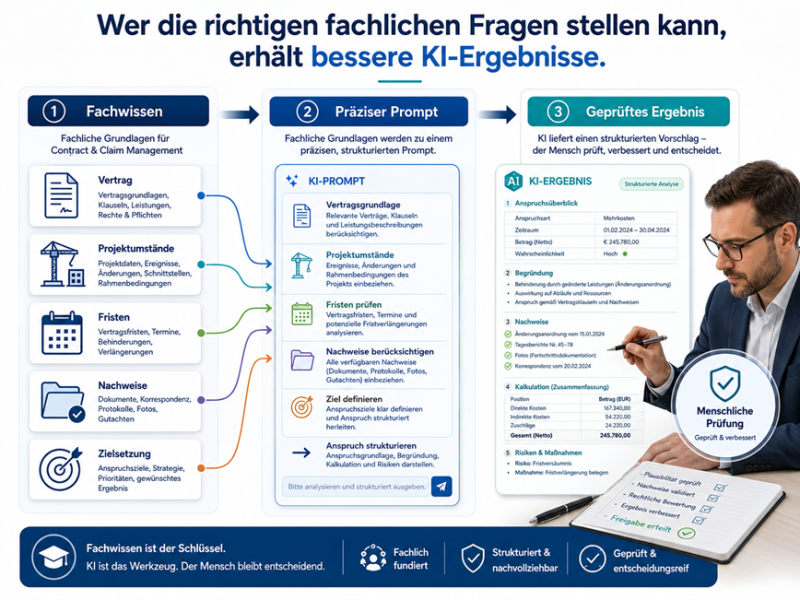
The benefit of AI depends largely on the questions being asked. In Contract & Claim Management, it is not enough to ask for a general assessment. The quality of the result depends on whether the relevant information, contractual references, project circumstances, deadlines, evidence and objectives are formulated correctly.
Those who do not know what matters professionally cannot create precise prompts.
Professional competence therefore determines:
- which information is provided to AI,
- which questions are meaningful,
- which assumptions need to be checked,
- which risks may be hidden in the result,
- which statements can be used,
- which results need to be adapted or rejected.
The training provided by the Contract Academy not only makes participants more confident in Contract & Claim Management. It also improves their ability to use AI as a professional working tool in a targeted manner.
The Future Lies in the Combination of Professional Expertise and AI
The decisive question is not whether AI replaces Contract & Claim Management. The decisive question is who is able to use AI competently.
Companies whose employees master the fundamentals of Contract & Claim Management can use AI productively: faster, more systematically and with better preparation. Companies without this competence, by contrast, risk using seemingly professional results whose professional reliability has not been sufficiently reviewed.
The training programs of the Contract Academy create the foundation for not trusting AI blindly, but using it consciously, critically and effectively.
Contract Academy: Professional Expertise Remains the Key
The Contract Academy provides the knowledge employees need to understand Contract & Claim Management professionally and apply it in practice. AI does not make this knowledge obsolete — on the contrary: it makes it more important.
The more powerful digital tools become, the more decisive the ability to correctly evaluate their results becomes.
AI can support. Professional competence decides.